
Home › Practice tests › Air Brakes
Air Brakes CDL Practice Test
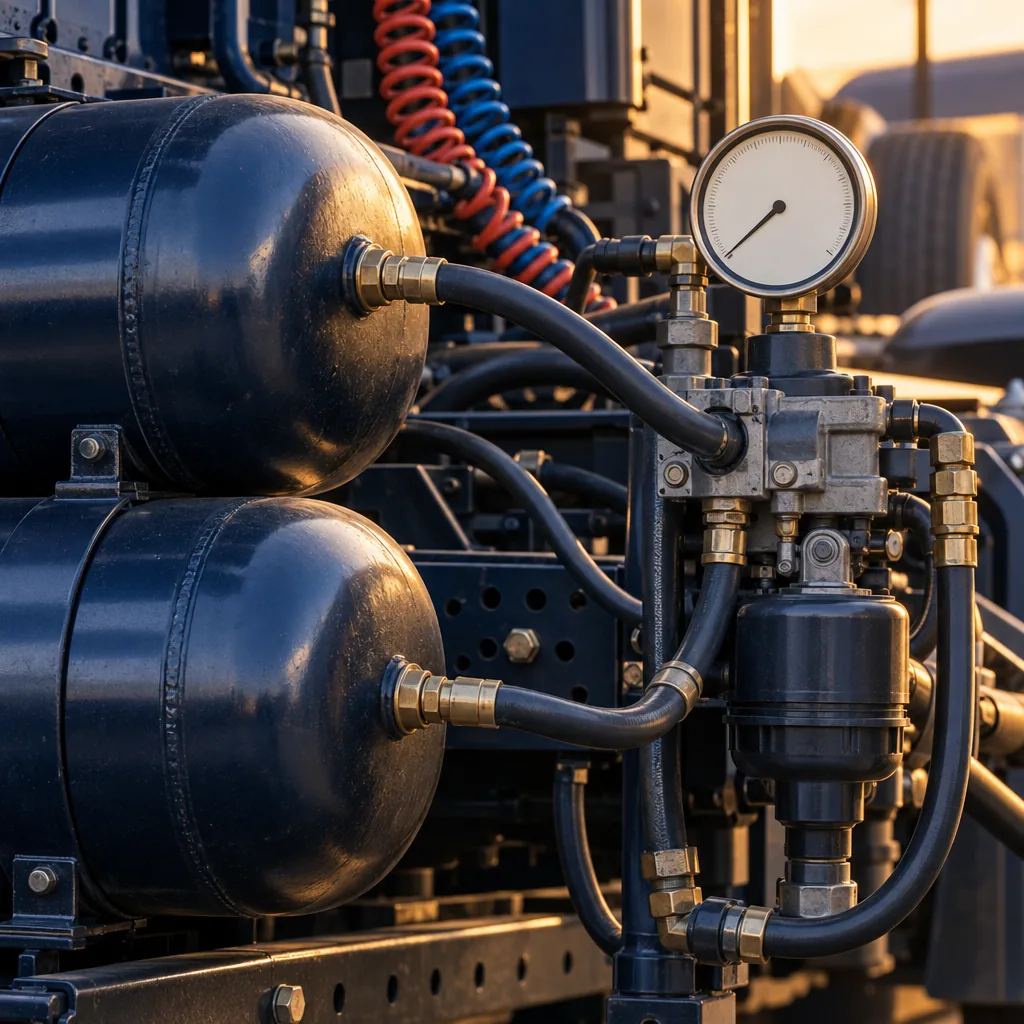
The Air Brakes test is required for any vehicle equipped with a full air brake system, an air-over-hydraulic brake system, or air-actuated parking brakes. It covers system components, dual air brake systems, parking brakes, brake fade, brake adjustment, leak rates, low-air warnings, emergency brakes, the application pressure gauge, and the daily air brake pre-trip inspection sequence.
Ready to test yourself? Take a free scored practice test in this category, or mix in all 500 questions.
Why this test exists
An air brake failure on a loaded combination vehicle can cause runaway, jackknife, or fire. The CDL Air Brakes test exists because air systems behave very differently from hydraulic brakes — drivers must understand pressure build, air loss tolerance, and stopping distance under load.
How to study this section
Memorize the seven steps of the air brake pre-trip check, the leak-down rates for single and combination vehicles, the warning signal pressure threshold, and the spring brake automatic application pressure range. Practice the order of operations — never rely on muscle memory in the booth.
62 practice questions
- Q1. Air brakes use compressed air to apply braking force. The three braking systems on most CMVs are:
- Q2. The compressor governor controls:
- Q3. Typical compressor cut-out pressure is approximately:
- Q4. The air pressure warning signal must activate before pressure drops below:
- Q5. Spring brakes typically apply automatically when air pressure falls to approximately:
- Q6. The air brake system air loss rate (with engine off, brakes released) for a single vehicle should no…
- Q7. For a combination vehicle, maximum allowed air loss with brakes released is:
- Q8. When inspecting the air brake system, you should first build pressure to:
- Q9. Brake fade is most likely on:
- Q10. The proper braking technique for a long downgrade is:
- Q11. The supply line (emergency line) on a tractor-trailer is connected by the:
- Q12. The service line (control line) is connected by the:
- Q13. The trailer hand valve (trolley valve, Johnson bar) should be used:
- Q14. A dual air brake system has:
- Q15. A leaking air tank with the pressure dropping rapidly while parked indicates:
- Q16. Brake chambers convert air pressure into:
- Q17. A slack adjuster controls:
- Q18. When checking manual slack adjuster travel, the rule of thumb is the chamber pushrod should not move…
- Q19. When draining air tanks, you should:
- Q20. The alcohol evaporator (used in some systems) helps prevent:
- Q21. The parking brake control on most newer trucks is:
- Q22. Bobtail tractors (no trailer attached) require:
- Q23. When the air brake system loses all pressure, what stops the vehicle?
- Q24. The required leak-down test before driving consists of:
- Q25. Anti-lock braking systems (ABS) on tractors and trailers are intended to:
- Q26. If the ABS warning light stays on after start-up:
- Q27. Stab braking is appropriate on:
- Q28. The tractor protection valve protects the tractor from:
- Q29. The trailer air supply valve (red knob) should be:
- Q30. The most common cause of brake fade on a long downgrade is:
- Q31. When parking on a downgrade, the front wheels should be turned:
- Q32. The proper sequence for the seven-step pre-trip air brake check ends with:
- Q33. The application pressure gauge shows:
- Q34. Rest of brake fade prevention includes:
- Q35. When you make an emergency stop in a vehicle with ABS, you should:
- Q36. The compressor is most often driven by:
- Q37. A water-saturated air brake system can lead to:
- Q38. Air brake supply pressure should generally fall between:
- Q39. A driver who hears continuous air leakage during a leak-down test should:
- Q40. The ratio of brake force from the front service brakes versus rear is balanced by:
- Q41. A 'full brake application' is performed during inspection by:
- Q42. Fanning the brakes during downhill descent will:
- Q43. The tractor protection valve closes automatically when trailer air pressure drops to:
- Q44. When uncoupling, before disconnecting the air lines you should:
- Q45. The function of the one-way check valve in the air system is to:
- Q46. A hissing sound that continues after the engine is shut off and brakes released usually indicates:
- Q47. You should never use the parking brake while:
- Q48. A safety valve on the supply tank typically vents at approximately:
- Q49. The brake system warning device may be:
- Q50. Modulating valve (treadle valve) is the:
- Q51. When testing the spring brakes during pre-trip you should expect:
- Q52. Air dryers in the system serve to:
- Q53. The S-cam in a drum brake system rotates to:
- Q54. Wedge brake actuators differ from S-cam brakes in that they:
- Q55. A glad hand seal that is cracked or missing will:
- Q56. The first sign of a low air pressure problem while driving is usually:
- Q57. When climbing a long upgrade, brake adjustment should:
- Q58. When the trailer service brake glad hand becomes disconnected, the trailer brakes will:
- Q59. When you apply the trailer hand valve, you should not use it to:
- Q60. A vehicle that has been sitting unused for several days may have:
- Q61. A driver should consider the brake system to be in unsafe condition when:
- Q62. After applying brakes during a stop, you should:
State-specific resources
Each U.S. state administers the CDL knowledge test through its own DMV. The federal questions are the same; the test scheduling, fees, and identification requirements vary. Start with your state's overview:
Alabama
Air Brakes questions tailored for Alabama drivers.
Alaska
Air Brakes questions tailored for Alaska drivers.
Arizona
Air Brakes questions tailored for Arizona drivers.
Arkansas
Air Brakes questions tailored for Arkansas drivers.
California
Air Brakes questions tailored for California drivers.
Colorado
Air Brakes questions tailored for Colorado drivers.