
Home › Practice tests › Combination Vehicles
Combination Vehicles CDL Practice Test
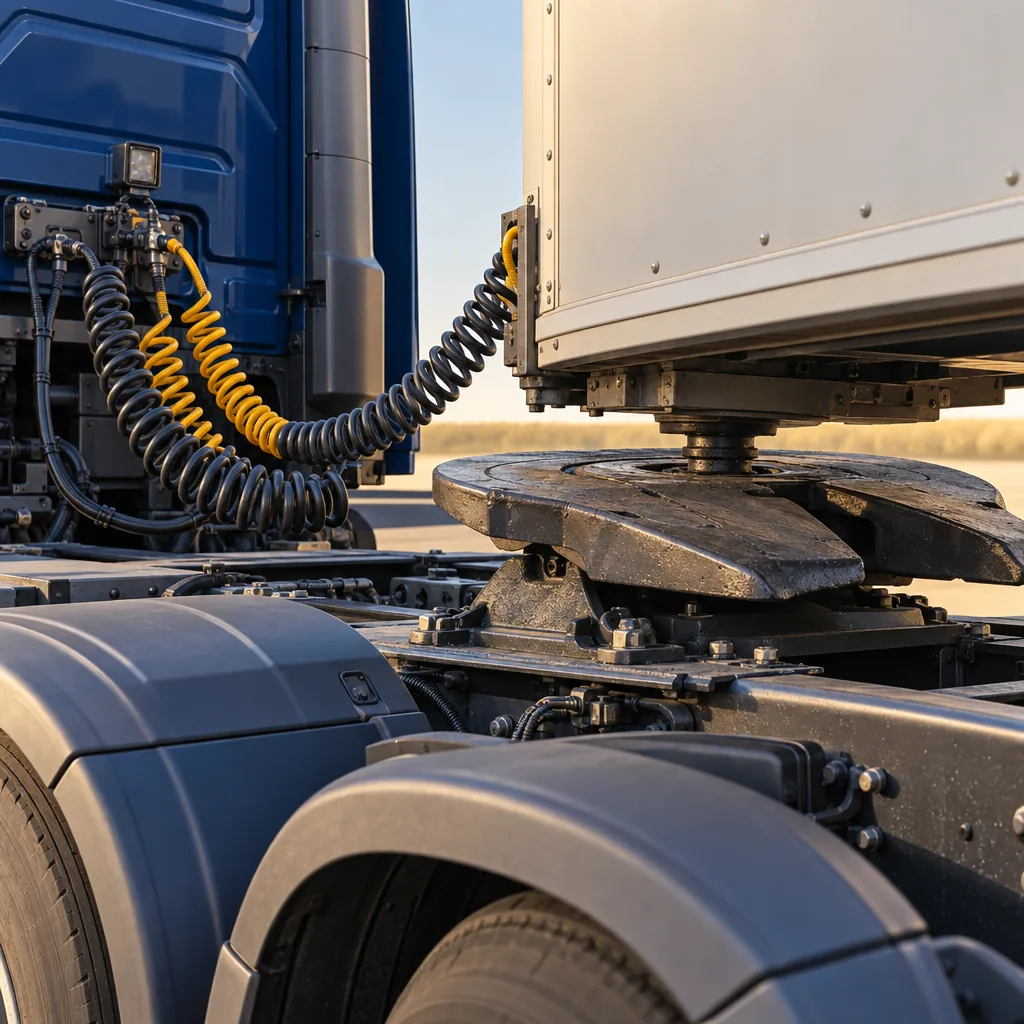
The Combination Vehicles test covers driving tractor-trailers and other combinations with a Gross Vehicle Weight Rating over 26,001 pounds where the towed unit exceeds 10,000 pounds. Topics include coupling and uncoupling, fifth wheel inspection, off-tracking, rearward amplification, jackknife prevention, rollover, antilock brake systems, and emergency procedures specific to articulated vehicles.
Ready to test yourself? Take a free scored practice test in this category, or mix in all 500 questions.
Why this test exists
Articulated vehicles fail in unique ways: trailer swing under braking, rearward amplification under steering, and jackknife under loss of traction. Combination Vehicle knowledge is required for any Class A applicant under 49 CFR 383.111.
How to study this section
Walk through the coupling sequence verbally until it's second nature. Know the safe-rolling rearward amplification factor, the difference between trailer service brakes and parking brakes, and what creates the conditions for a tractor jackknife.
64 practice questions
- Q1. A combination vehicle is generally defined as:
- Q2. The 'fifth wheel' on a tractor is:
- Q3. The kingpin is part of the:
- Q4. When coupling, you should approach the trailer:
- Q5. After backing under the trailer, you should:
- Q6. Visual inspection of the fifth wheel coupling must confirm:
- Q7. The trailer's landing gear should be:
- Q8. When uncoupling, after lowering the landing gear and disconnecting glad hands you should:
- Q9. The coupling height check before backing under the trailer is critical because:
- Q10. A high-coupled trailer (kingpin riding above the jaws) can result in:
- Q11. Off-tracking by the trailer means:
- Q12. Rearward amplification means:
- Q13. A trailer jackknife is:
- Q14. The first sign of a tractor drive-wheel skid is often:
- Q15. To prevent rollover with a high center of gravity, you should:
- Q16. A loaded trailer with a high center of gravity is most prone to roll over:
- Q17. Cargo loaded too far to one side will:
- Q18. Cargo loaded too far forward can:
- Q19. Cargo loaded too far rearward can:
- Q20. When checking trailer brakes via the hand valve, you should:
- Q21. The fifth wheel should be greased:
- Q22. Air lines and electrical cables between tractor and trailer must be:
- Q23. When backing a trailer, the trailer initially turns:
- Q24. When backing into a tight spot, you should:
- Q25. The 'safety latch' on the fifth wheel locking lever:
- Q26. The legal maximum trailer length on the National Network is generally:
- Q27. A converter dolly is used to:
- Q28. When uncoupling a trailer, the order generally includes:
- Q29. A leaky air line between tractor and trailer will most likely cause:
- Q30. Stopping distance for a fully loaded combination vehicle is:
- Q31. Trailer ABS sensors are typically located at:
- Q32. When climbing a long uphill grade with a heavy load, you should:
- Q33. When the trailer wheels lock during heavy braking, you should:
- Q34. Tracks of the tractor and trailer in a tight right turn should be:
- Q35. Antilock brakes on a tractor without ABS on the trailer:
- Q36. When pulling a trailer through a sharp curve, the load can shift if it is not:
- Q37. The trailer hand valve is sometimes called:
- Q38. A heavy trailer pushing on the tractor going downhill is called:
- Q39. The forward thrust between trailer and tractor on a hard stop is absorbed by:
- Q40. When approaching an intersection in a combination vehicle, you should:
- Q41. The most common cause of trailer wheel lockup in non-ABS trailers is:
- Q42. Trailer length affects:
- Q43. When parking a combination vehicle, you should:
- Q44. Glad hand color coding is required because:
- Q45. Cargo securement requirements depend on:
- Q46. Inspecting the rear of a trailer at a stop should include:
- Q47. When driving across railroad tracks with a low-clearance trailer (lowboy), you should:
- Q48. The trailer brake valve (hand valve) is intended for use:
- Q49. A coupled tractor-trailer with the trailer brakes locked and the tractor moving forward will cause:
- Q50. The risk of rollover is greatest when:
- Q51. When you must back into a busy area, you should:
- Q52. A tractor-trailer encountering a steep downgrade should choose a gear:
- Q53. The blind spots of a tractor-trailer include:
- Q54. When a passenger car cuts in front of you, you should:
- Q55. A trailer with sliding tandems lets you:
- Q56. When sliding the fifth wheel forward, the load on the steering axle:
- Q57. A pressure test of trailer air lines should include:
- Q58. When making a long left turn at an intersection, you should:
- Q59. A combination vehicle's empty trailer:
- Q60. When making a tight backing maneuver, looking ahead in your mirrors to predict trailer movement is b…
- Q61. Failing to set the trailer parking brake before uncoupling can cause:
- Q62. When the trailer landing gear sticks during raising or lowering, you should:
- Q63. When you cannot see the spotter in the mirror while backing, you should:
- Q64. The forward visibility of a tractor's hood and mirrors creates a blind area in front of the cab of a…
State-specific resources
Each U.S. state administers the CDL knowledge test through its own DMV. The federal questions are the same; the test scheduling, fees, and identification requirements vary. Start with your state's overview:
Alabama
Combination questions tailored for Alabama drivers.
Alaska
Combination questions tailored for Alaska drivers.
Arizona
Combination questions tailored for Arizona drivers.
Arkansas
Combination questions tailored for Arkansas drivers.
California
Combination questions tailored for California drivers.
Colorado
Combination questions tailored for Colorado drivers.